A Fool with a Tool Is Still a Fool
AI doesn't change that. It amplifies it. There has never been a better time to sell the AI sticker—but massive investment in tools without investment in people is the real problem.
AI Doesn’t Change That. It Amplifies It.
There has never been a better time to sell the AI sticker. Global AI spending is forecast to reach well over a trillion dollars in the next few years, and organizations rush to embed AI into products, services, and infrastructure. Yet for many, the real story underneath the hype is more awkward: massive investment in tools, little investment in people. Therefore, the AI backlash is real and if social media continuous in 2026, the pushback on AI is likely going to be stronger in 2026.
Tools Without Skills = Expensive Illusion
Surveys consistently show that while AI adoption is rising, value realization is not keeping pace. Many companies sit in the same position: they have rolled out AI tools widely, but only a fraction of employees use them meaningfully in day-to-day work.
BCG’s “AI at Work” research, for example, highlights a “silicon ceiling”: more than three-quarters of leaders and managers report using generative AI several times a week, while regular usage among frontline employees has stalled around half. Other studies echo this finding, showing that AI ROI is uneven and heavily dependent on how deeply organizations embed AI into workflows, not just how many tools they deploy.
In short: buying AI is easy. Turning it into performance is hard.
The AI Amplifier Effect
AI acts less like a magic ball and more like an amplifier:
- Good judgment, structured thinking, and clear problem framing get multiplied.
- Poor reasoning, vague questions, and broken processes also get multiplied—quicker, louder, and at scale.
Without those foundations, AI simply accelerates confusion. The tool is powerful; the way it is used is not.
From Tool-Centric to Skills-Powered
A skills-powered organization treats AI as a capability multiplier, not a shortcut. That shows up in several concrete shifts:
- AI literacy for everyone. Not just “how to click the button,” but how AI works, where it fails, and how to question outputs. Reference: OECD’s analysis on the AI skills gap.
- Workflow redesign, not surface automation. BCG and others emphasize that real value appears when companies rethink end-to-end workflows, rather than sprinkling AI on top of existing steps.
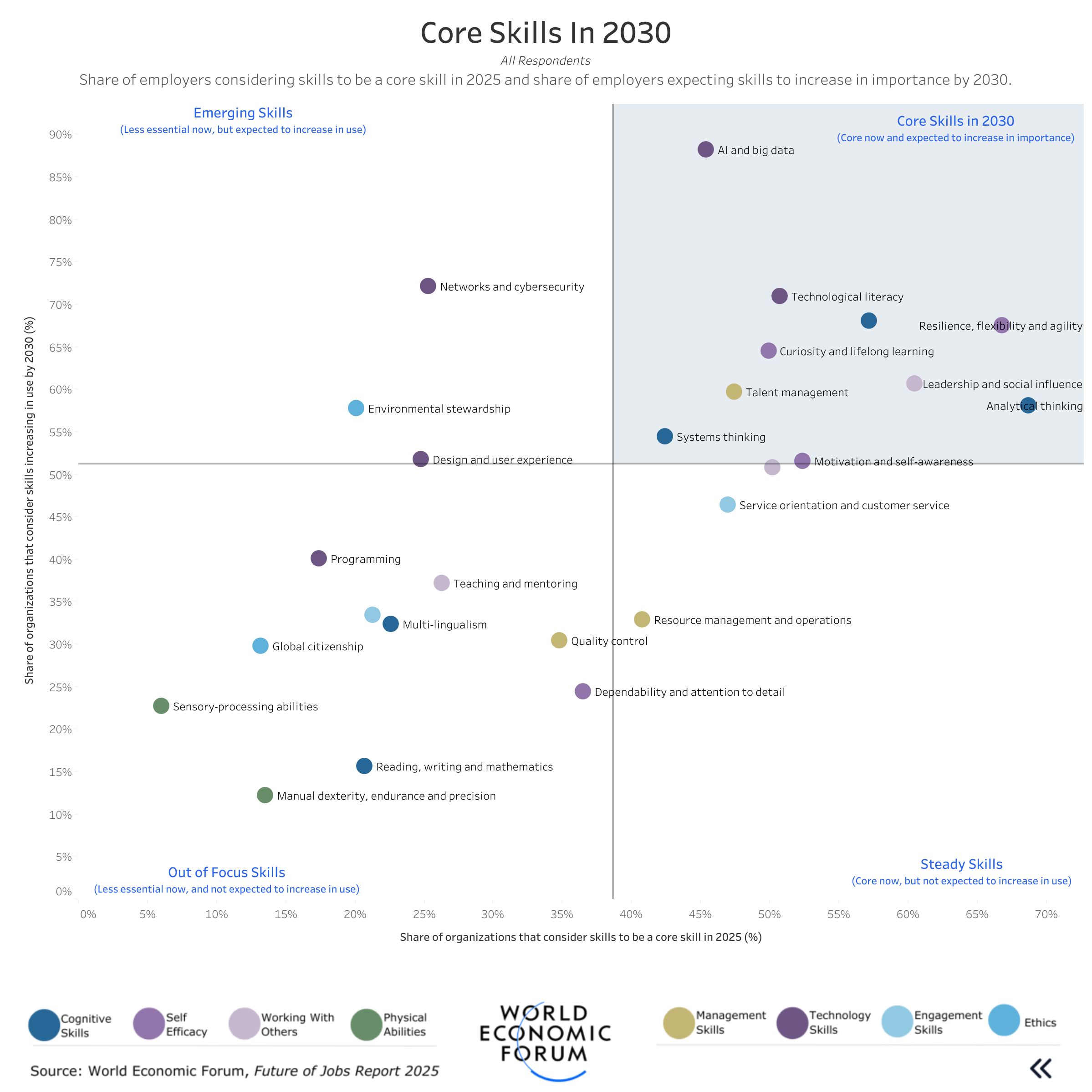
- Human judgment at the center. The most in-demand skills in AI-exposed jobs are management, problem solving, and business skills—not only technical ones. Source: OECD Employment Outlook 2025.
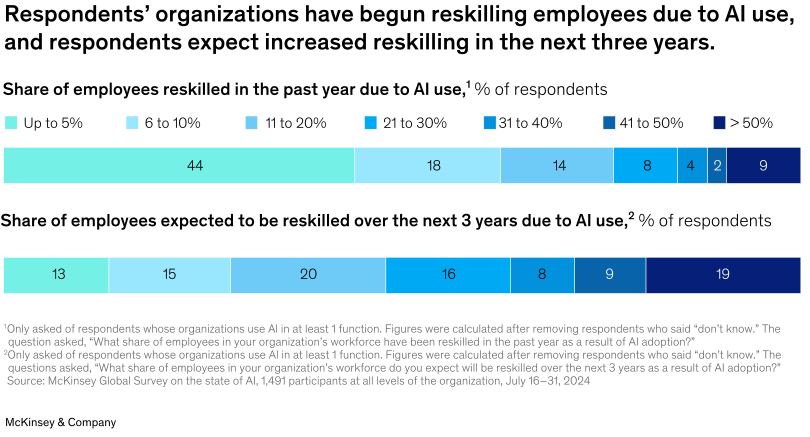
Why Skills Beat Shortcuts
Skills-powered organizations do some difficult, long-horizon work:
- Map which skills actually matter for AI-augmented roles (e.g., interpreting AI suggestions, designing prompts that reflect policy and ethics, understanding uncertainty).
- Invest in structured learning paths and communities of practice, not just one-off workshops.
- Align performance, incentives, and career paths with learning, so AI capability is rewarded—not just tool usage.
Sources & References
5 sources cited in this article
AI at Work: Momentum Builds but Gaps Remain
Research highlighting the "silicon ceiling" where AI adoption among frontline employees has stalled despite leadership usage.
Artificial Intelligence and the Changing Demand for Skills in the Labour Market
Analysis showing workers need stronger cognitive, digital, and business skills to use AI effectively.
Bridging the AI Skills Gap
Warning that current training supply is unlikely to meet growing demand for AI literacy.
OECD Employment Outlook 2025
Report on in-demand skills in AI-exposed jobs including management, problem solving, and business skills.