Your AI Strategy Is Now an Energy, Capital, and Governance Strategy
For most of the last decade, "where does this run?" was a technology question. In 2026, AI strategy — it is about compute, power, capital, and governance.
Your AI Strategy Is Now an Energy, Capital, and Governance Strategy
For most of the last decade, "where does this run?" was a technology question. Cloud region. Latency. Redundancy. The CTO picked AWS, Azure, or Google Cloud, and the rest of the business moved on. That framing no longer works.
In 2026, AI strategy is no longer primarily about models, prompts, or vendors. It is increasingly about access to compute, availability of power, control of costs, and the governance mechanisms that determine whether AI creates enterprise value or becomes an expensive experiment.
The organisations creating meaningful outcomes with AI are not necessarily using the most advanced models and tools. They are the ones managing AI as a business capability with financial discipline, clear ownership, talented people and measurable outcomes.
The Hidden Layer Beneath Every AI Initiative
Most employees see copilots, chatbots, agents, and AI-powered workflows. What they do not see is the infrastructure and governance underneath.
Every prompt, inference call, agent action, and model response consumes compute capacity delivered through hyperscale data centres. Those facilities depend on GPUs, networking infrastructure, electricity, water, and increasingly scarce physical capacity. Every token generated by an AI model is effectively electricity converted into business output — not the same as business value.
That output may be customer service automation, software development, marketing content, research, analytics, or operational decision support. The question executives should ask is not whether AI generates output or would be adopted.
The question is whether it generates enough business value to justify the resources consumed to produce it. That distinction matters because compute is rapidly becoming one of the largest cost categories in AI adoption.
The lesson is not about the size of the number. The lesson is that compute is no longer effectively infinite, and it is certainly not free. Without governance, usage controls, model-routing policies, and workload prioritisation, many enterprises risk creating their own version of the same problem: AI demand growing faster than the value it creates. Research on AI agent sprawl makes this governance gap explicit.
What Actually Changed
For the last two years, most AI discussions focused on models. GPT versus Claude. Open-source versus proprietary. Fine-tuning versus retrieval. Prompt engineering versus agents. Those discussions still matter, but they are no longer the primary constraint. The constraint has moved upstream.
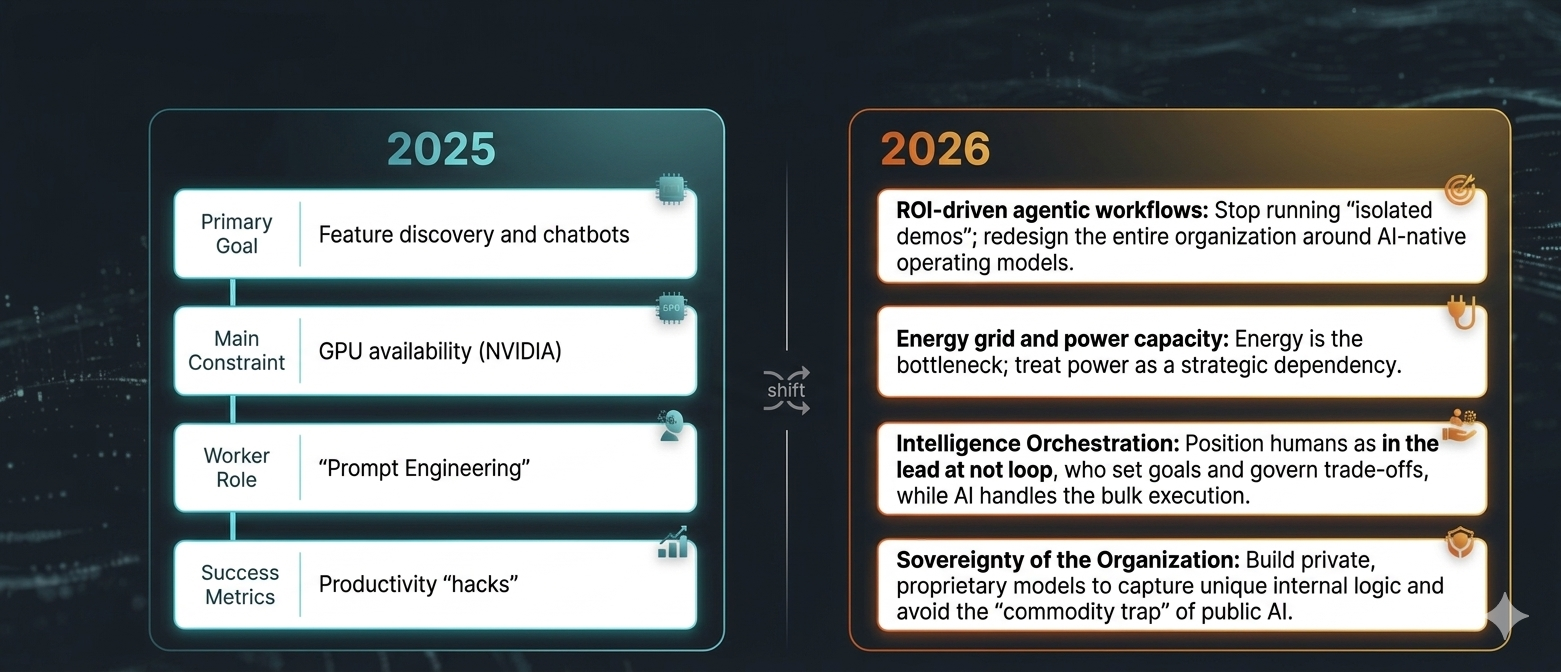
Power
The world's largest AI providers are competing for electricity at unprecedented scale. Training frontier models and serving millions of users requires gigawatts of reliable power capacity. In several regions, grid interconnection queues are measured in years rather than months.
Compute
Demand for advanced GPUs continues to outpace supply. Access to high-performance compute is increasingly becoming a strategic advantage rather than a commodity purchase. As hyperscalers and AI labs secure long-term capacity, availability becomes a business issue rather than a technical one.
Capital
The economics have shifted dramatically. Hyperscalers are collectively planning hundreds of billions of dollars in AI infrastructure investments, with forecasts suggesting AI-related capital expenditure will reach unprecedented levels during the second half of this decade.
This is not ordinary technology spending. It is infrastructure spending on the scale of utilities, transportation networks, and industrial supply chains.
Governance
The final constraint is often the least discussed. As AI adoption expands across departments, organisations frequently lose visibility into who is using which models, for what purpose, and at what cost.
What starts as a pilot can quickly become thousands of independent AI-enabled workflows generating millions of inference calls each month.
Without governance, organisations discover they have optimised for adoption rather than outcomes.
The ROI Problem Nobody Wants to Discuss
The uncomfortable reality is that AI adoption and AI value are not the same thing. Many organisations measure activity. Few measure outcomes. A dashboard showing millions of AI interactions may look impressive. A dashboard showing reduced cost-to-serve, faster revenue cycles, increased customer retention, or higher productivity is far more valuable.
Boards do not fund prompts or copilots. They fund outcomes.
Why Governance Is Becoming a Competitive Advantage
The next generation of AI leaders will not be distinguished by who deploys the most AI. They will be distinguished by who deploys AI most effectively. That requires governance. Not governance as bureaucracy. Governance as economic control. Every organisation and executive team should be asking before scaling:
- Which business outcomes justify our AI investments?
- Who is accountable for delivering those outcomes?
- Who owns AI governance?
- Do we have visibility into AI consumption and utilisation across the organisation?
- What are the biggest risks of AI adoption for our business?
- What skills will we need that we do not have today?
- If our competitors fully embraced AI over the next three years, where would they outperform us?
- How do we turn organisational knowledge into a competitive asset?
Sources & References
4 sources cited in this article
Match Your AI Strategy to Your Organization's Reality
HBR analysis showing that organisations creating meaningful AI outcomes manage it as a business capability with financial discipline and measurable outcomes.
A Governance Maturity Model for Managing AI Agent Sprawl in Business Operations
Acharya, V. (2026). Research on governance frameworks for managing AI agent proliferation and the risk of AI demand outpacing value creation.
Power Grid Infrastructure for AI Data Centers
Sajadi, A., Za'ter, M. E., Vabson, M., Baker, K., & Hodge, B. M. (2026). Analysis of power grid constraints for AI data centres, with grid interconnection queues measured in years.
Financing the AI Buildout
Van Nieuwerburgh, S. (2026). The economics of AI infrastructure investment — spending on the scale of utilities and industrial supply chains.
Related Articles
AI in the AEC Value Chain — Why ROI Is Still Missing
AI is everywhere right now. And yet, if you look closely, something feels off. Despite widespread experimentation, tangible ROI remains limited. This isn't because AI lacks potential. It's because of where—and how—it's being applied.
Reflection WEF in Davos – From Experimentation in 2025 to ROI in 2026
What began as curiosity and experimentation has evolved into a question of infrastructure, economics, and control. In hindsight, the rapid pace of change reveals a clear pattern from late 2024 to early 2026.